
How Rice Milling Works: Step-by-Step Process from Paddy to Perfect Grain
Introduction
Rice milling is a sophisticated multi-stage process that transforms raw paddy into polished, market-ready rice grains. This critical agricultural processing operation involves carefully removing the husk, bran layers, and impurities while preserving the nutritional integrity and quality of the final product. Modern rice milling has evolved from traditional manual methods to highly automated systems that can process thousands of tons daily while maintaining consistent quality standards.
The rice milling industry plays a pivotal role in global food security, as rice feeds over 3.5 billion people worldwide. Understanding the intricacies of this process is essential for mill operators, agricultural professionals, and anyone involved in the rice supply chain.
Overview of the Rice Milling Process
The Fundamental Objective
The primary goal of rice milling is to remove approximately 20% husk, 8-12% bran layers, and produce 68-72% clean, edible white rice while minimizing breakage and maintaining grain quality. This process transforms the rough, inedible paddy into nutritious, consumer-ready rice that meets both domestic and international quality standards.
Key Components of Paddy
Before delving into the milling process, it's crucial to understand paddy composition:
- Husk (20%): The tough outer protective layer
- Bran and Germ (11%): Nutrient-rich layers containing oils, vitamins, and minerals
- Endosperm (69%): The starchy, edible portion that becomes white rice
Step-by-Step Rice Milling Process
Step 1: Paddy Cleaning and Pre-Processing
Purpose and Importance
The milling process begins with thorough cleaning to remove foreign materials that could damage machinery and compromise final product quality. This critical first step ensures optimal performance throughout the entire milling chain.
Cleaning Equipment and Methods
Pre-Cleaners: These machines use vibrating screens and air aspiration systems to remove larger impurities such as straw, leaves, stones, dust, and weed seeds. The cleaning capacity is typically set at 1.5 times the milling capacity to ensure thorough processing.
Destoning Process: Specialized destoning machines use gravity separation principles to remove stones and heavy impurities that are similar in size to paddy grains. This process works on the principle of specific gravity, where heavier materials settle while lighter paddy grains are lifted by positive air flow.
Quality Standards: Effective cleaning reduces foreign matter to below 0.75%, with poisonous weed seeds limited to 0.4% and moisture content maintained between 12-14%.
Step 2: Parboiling (Optional Process)
Understanding Parboiling
Parboiling is an optional pre-milling treatment that involves partially cooking paddy through steaming and soaking. This process offers significant advantages in terms of nutritional enhancement and milling efficiency.
The Three-Stage Parboiling Process
Pre-Steaming (Kacchi): Paddy is exposed to steam at temperatures of 95-100°C for a predetermined time to create gaps between the kernel and husk. Modern systems optimize steam pressure to 0.5-1 bar to prevent grain damage.
Soaking: Grains are immersed in hot water (70-80°C) for 2-6 hours to achieve uniform moisture distribution and starch gelatinization. Advanced systems maintain consistent water temperature through closed-loop circulation.
Post-Steaming (Pakki): Final steaming completes the gelatinization process and develops the characteristic golden color of parboiled rice.
Benefits of Parboiling
- Increases milling yield by 2-5%
- Reduces grain breakage during processing
- Enhances nutritional value by driving nutrients from bran into the endosperm
- Improves storage life and resistance to insect infestation
- Lowers glycemic index compared to raw rice
Step 3: Drying and Conditioning
Moisture Management
Proper drying reduces moisture content to optimal levels (18-22%) before milling begins. This step is crucial for achieving desired milling quality and preventing excessive breakage during processing.
Drying Methods
- Natural Sun Drying: Traditional method using solar energy
- Artificial Drying: Using heated air systems for controlled moisture reduction
- Modern Drying Systems: Continuous flow dryers with precise temperature and airflow control
Step 4: Husking (Dehusking)
The Husking Process
Husking removes the tough outer husk layer to reveal brown rice underneath. This process requires careful balance between complete husk removal and minimal grain damage.
Husking Technologies
Rubber Roll Huskers: The most common method uses two rubber rolls rotating at different speeds to create friction that loosens and removes the husk. The speed differential and pressure are precisely controlled to optimize husking efficiency while minimizing breakage.
Impeller-Type Huskers: These machines use centrifugal force and impact to remove husks, particularly effective for indica rice varieties. They achieve superior performance compared to conventional systems while reducing milling losses.
Step 5: Paddy Separation
Separation Technology
After husking, the mixture contains both brown rice and unhusked paddy grains. Paddy separators use differences in specific gravity, size, and aerodynamic properties to separate these components.
Separation Methods
Gravity Separators: Use air flow and vibration to separate lighter brown rice from heavier unhusked paddy. The heavier paddy grains are recirculated back to the husker for re-processing.
Indented Cylinder Separators: Employ rotating cylinders with precisely sized indentations to separate grains based on length and shape differences.
Step 6: Milling and Whitening
The Milling Process
Milling removes the bran layer from brown rice to produce white rice. This process must be carefully controlled to achieve the desired degree of milling while minimizing grain breakage.
Whitening Technologies
Friction-Type Whiteners: Use rotating stone or carborundum surfaces to remove bran through abrasion. These machines allow precise control of whitening intensity through adjustable pressure settings.
Abrasive Whiteners: Employ abrasive chambers where rice grains are rubbed against rough surfaces to remove bran layers. Multiple passes through different whitening stages achieve progressive bran removal.
Step 7: Rice Polishing
Polishing Enhancement
Polishing gives rice grains a bright, attractive appearance by removing any remaining bran particles and smoothing the surface. This process significantly impacts market value and consumer acceptance.
Polishing Methods
Water Polishing: Uses fine water mist combined with friction to achieve a glossy finish. The water helps remove surface dust while creating the characteristic shine.
Friction Polishing: Employs controlled friction between grains to smooth surfaces and enhance appearance. Modern polishers use precise pressure control to avoid over-processing.
Step 8: Grading and Sorting
Size Classification
Rice grading separates milled rice into different categories based on grain length, width, and quality parameters. This step ensures product uniformity and enables premium pricing for higher-grade rice.
Grading Equipment
Length Graders: Use rotating cylinders or vibrating screens to separate grains by length:
- Head Rice: Whole grains longer than 75% of average grain length
- Large Broken: Grains 50-75% of average length
- Small Broken: Grains 25-50% of average length
- Brewers Rice: Grains less than 25% of average length
Step 9: Color Sorting
Optical Sorting Technology
Color sorters use advanced optical sensors and high-speed ejection systems to remove discolored, damaged, or foreign grains. These machines significantly enhance final product quality and appearance.
Step 10: Final Quality Control and Testing
Quality Assessment Parameters
Comprehensive quality control ensures the final product meets industry standards and customer specifications.
Step 11: Packaging and Storage
Final Processing Stage
The milled rice is weighed, packaged in various sizes (typically 50kg bags for bulk sales), and prepared for distribution. Modern packaging systems ensure accurate weights and proper sealing to maintain freshness.
Modern Rice Milling Technology and Equipment
Automated Milling Systems
Integrated Mill Design
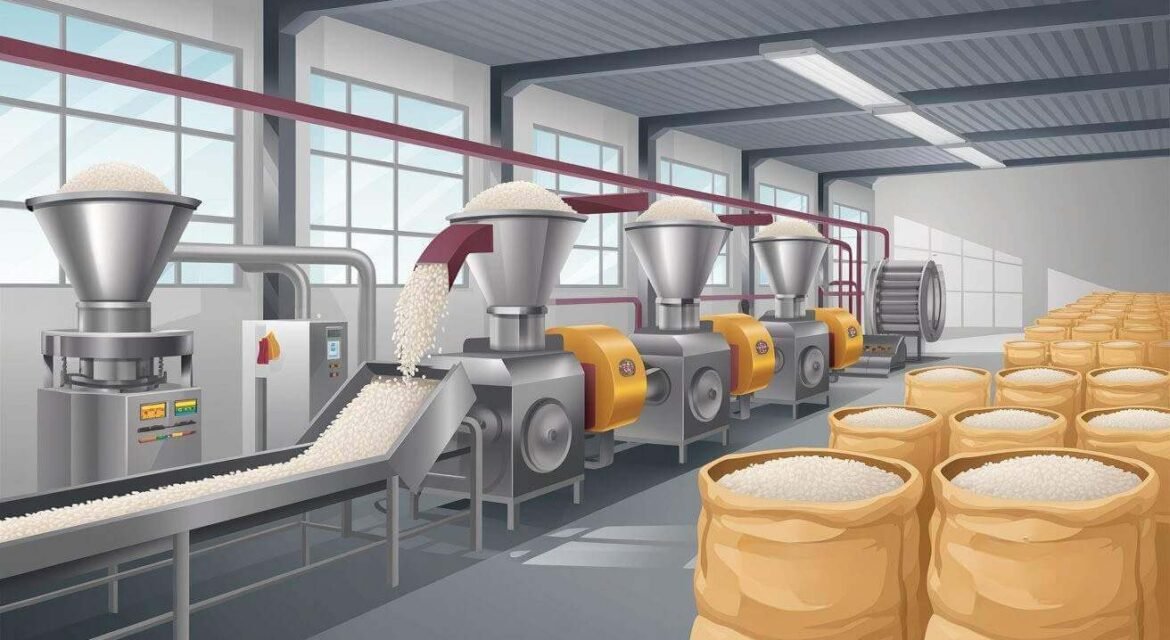
Modern rice mills feature fully integrated systems that automate the entire process from cleaning to packaging. These systems offer:
- Continuous Processing: Uninterrupted flow from paddy input to packaged rice output.
- Quality Monitoring: Real-time sensors monitor moisture, temperature, and processing parameters.
- Data Analytics: Advanced systems collect and analyze production data for optimization.
- Remote Control: Centralized control systems enable operators to monitor and adjust multiple processes simultaneously.
Capacity and Scale Considerations
Mill Size Classifications
Rice mills are categorized by processing capacity:
- Mini Rice Mills: 1-5 tons per day capacity, ideal for local processing.
- Small Rice Mills: 5-20 tons per day, suitable for community-level operations.
- Medium Rice Mills: 20-100 tons per day, serving regional markets.
- Large Commercial Mills: 100+ tons per day, for industrial-scale processing.
Investment Considerations
Mill setup costs vary significantly based on capacity and automation level:
- 1-ton mill: ₹8-13 lakhs ($10,000-16,000)
- 5-ton mill: ₹30-36 lakhs ($37,000-44,000)
- 10-ton mill: ₹60-72 lakhs ($73,000-88,000)
- Large commercial mills: ₹5+ crores ($600,000+)
Byproduct Utilization and Value Addition
Rice Husk Applications
Energy Generation
Biomass Fuel: Husk serves as an excellent biofuel for boilers and power generation. Many mills now use husk-fired boilers to meet their energy needs, creating a sustainable, cost-effective energy cycle.
Industrial Applications
Silica Production: Husk ash contains 85-95% silica, valuable for steel, cement, and refractory industries.
Rice Bran Commercialization
Oil Extraction
Rice bran oil (RBO) extraction represents one of the most lucrative byproduct applications, producing a high-value edible oil with excellent nutritional properties.
Animal Feed
Processed rice bran serves as high-quality animal feed supplement, rich in protein, fiber, and essential nutrients for poultry, cattle, and aquaculture.
Future Trends in Rice Milling
The rice milling industry continues evolving with emerging technologies:
- Artificial intelligence for quality control and process optimization
- IoT sensors for real-time monitoring and predictive maintenance
- Blockchain technology for supply chain traceability
- Advanced sorting technologies using hyperspectral imaging
Conclusion
Rice milling represents a complex, technology-intensive process that transforms raw paddy into high-quality, market-ready rice while maximizing resource utilization and minimizing waste. The evolution from traditional manual methods to modern automated systems has revolutionized the industry, enabling consistent quality, higher yields, and sustainable operations.
Success in modern rice milling requires understanding each process step, from initial cleaning through final packaging, while maintaining strict quality control and optimizing operational efficiency. The integration of advanced machinery, automation systems, and data analytics continues to drive improvements.
The effective utilization of byproducts—rice husk and bran—transforms potential waste into valuable revenue streams, supporting both profitability and environmental sustainability. As global demand for rice continues growing, efficient milling operations become increasingly critical for food security and economic development.